
Important Criteria for dropped kerbs and driveways: Ensuring Feasibility
Before applying for a new dropped kerb and driveway, check your proposal against these key criteria to ensure the project’s feasibility:
1. Sufficient Space for Parking
To comply, your property should have:
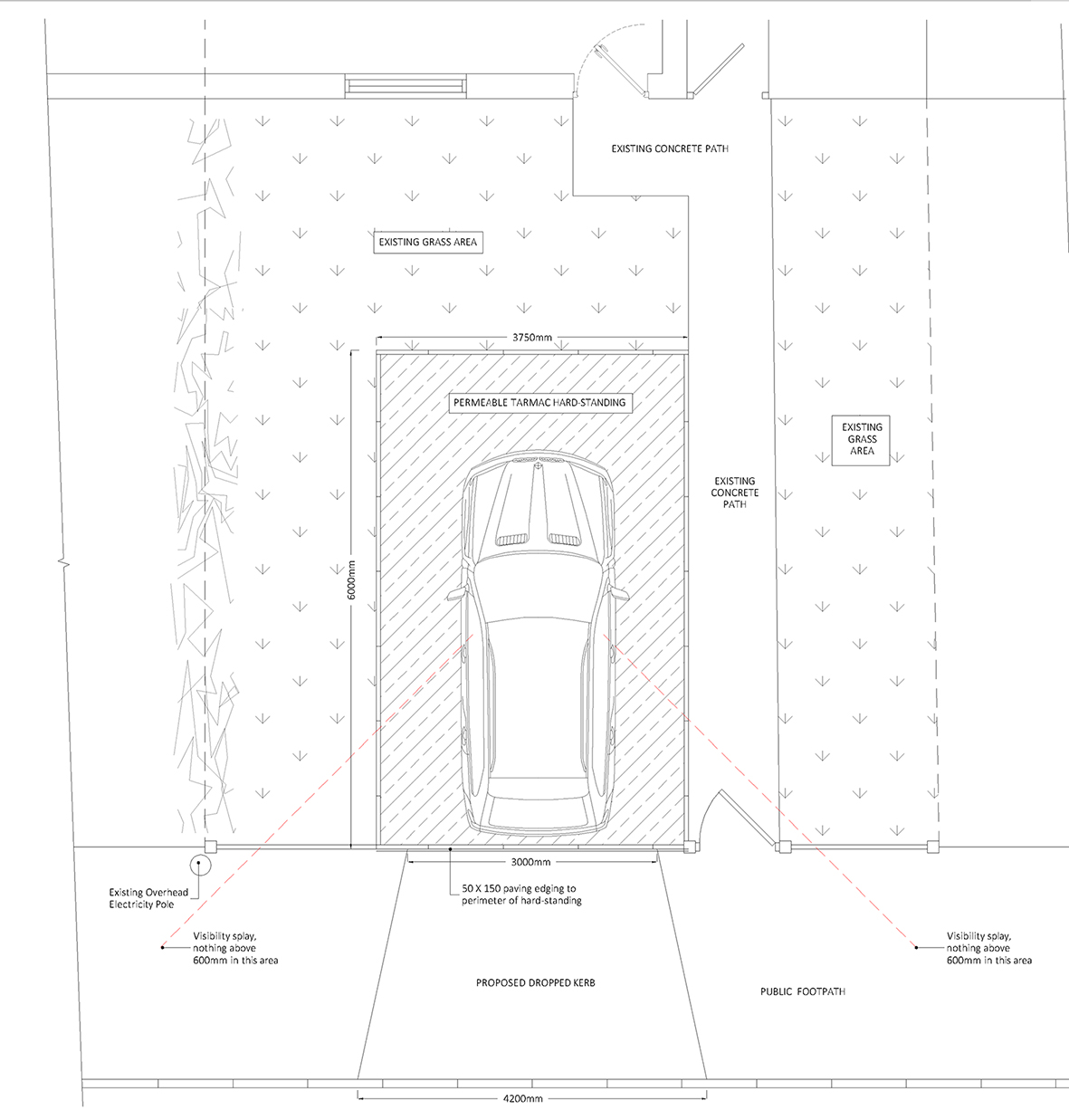
- A minimum parking space length of 4.8 metres from the property boundary to your building, ensuring vehicles do not hang over the highway.
- A greater minimum length of 6 metres if parking is in front of a garage or primary entrance, which must allow for easy exit in emergencies.
Moreover, the parking space should be at a right angle to the highway, allowing a vehicle to enter and exit in one movement. Councils prohibit manoeuvring on the footway to maintain pedestrian safety.
2. Width and Access Requirements
For a single vehicle crossing, the council mandates a minimum parking bay width of 2.4 metres, unobstructed by trees, street furniture, or structural features like bay windows. Any obstruction within this space could prevent access or complicate manoeuvring, which is why ensuring a clear, dedicated space is crucial.
3. Visibility and Safety Standards
Ensuring good visibility for both pedestrians and drivers is one of the most important aspects of kerb planning. Councils use two dimensions—called the X and Y distances—to measure adequate sightlines:
- Footway Visibility: A 2.0m setback with no obstructions above 0.6 metres for clear sightlines at entry points.
- Carriageway Visibility: Typically a 2.4m setback from the kerb, with further requirements based on road speed (e.g., 25 metres for a 20 mph road, increasing to 120 metres for 40 mph). If these spays cannot be met we will attempt to justify the proposal as best as possible based on local circumstances.
Council inspectors assess sightline obstructions like trees or parked vehicles within these splays and may deny applications if visibility does not meet Department for Transport (DfT) standards.
4. Proximity to Road Junctions
To avoid increased traffic conflict, a dropped kerb must be located a minimum of 10 metres from a junction. For major roads or particularly busy junctions, this distance may increase to 15 or 20 metres. In cases where the property is on a corner, councils often recommend situating the kerb on the minor road side to enhance safety and flow.
5. Drainage Compliance
To avoid water runoff issues, councils require adequate drainage within property boundaries, preventing water from draining onto the public footway. This reduces both potential flooding risks and slip hazards, contributing to overall pavement safety.
6. Street Furniture and Utility Considerations
All street furniture, such as lamp posts, must be situated at least 1.5 metres away from the proposed crossing, and the relocation of any nearby utilities (e.g., utility cabinets or poles) is the applicant’s responsibility. When utility services need to be moved, the applicant must coordinate with the relevant providers, bearing all associated costs.
Contact form
7. Tree Proximity
Trees along pavements present additional challenges. If a dropped kerb impacts tree roots or requires the removal of a tree, the council may consider this if the applicant agrees to fund a replacement tree. The process can be complex, involving neighbouring property consultations, and typical costs for tree removal and replacement can reach up to £3,000.
8. Restrictions on Multiple Access Points
To maintain traffic safety, councils discourage creating multiple vehicle access points for single properties, as this increases turning points and potential traffic conflicts. If you believe a secondary access would significantly enhance safety, you must demonstrate why improvements cannot be achieved through a single access point.
9. Compliance with Classified Road and Conservation Area Rules
For properties on classified roads or in conservation areas, additional planning permission may be required. In these cases, the parking space must be sufficient for vehicles to turn on the property and exit in a forward direction, which contributes to both safety and road efficiency.
Planning Application and Installation Process
After ensuring your proposal meets self-assessment criteria, it’s time to gather the required documents:
- Scaled Drawings: Illustrating dimensions, distances from property lines, road features, and surrounding structures.
- Impact Assessments (if applicable): For properties near environmental or historical areas, you may need specific assessments, such as those addressing tree preservation or drainage impact.
- Application Fees: Councils charge fees for processing and inspecting applications, which vary depending on location and project scope.
Once submitted, the council reviews the application and typically conducts a site inspection to verify visibility, safety, and compliance with guidelines.
Installation Requirements
Upon approval, construction must be performed by a council-approved contractor or one holding the necessary permits, such as a Section 50 permit, which allows work on highways. Contractors must adhere to council standards, ensuring the kerb design does not disrupt drainage, utilities, or road safety.
Ensuring Success with Dropped Kerb Planning
With various requirements and complex standards, dropped kerb applications can be daunting. Dropped Kerb Planning offers professional guidance and support at every stage, ensuring a smooth, compliant process from initial assessment to final construction. Led by a Chartered Landscape Architect, we assist clients with tailored solutions, identifying potential challenges early and preparing council-ready documentation.
Whether you’re applying for a new kerb or modifying an existing one, contact Dropped Kerb Planning for expert assistance. We ensure your application aligns with local standards, so you can enjoy a safe, compliant, and fully approved vehicle crossing.


